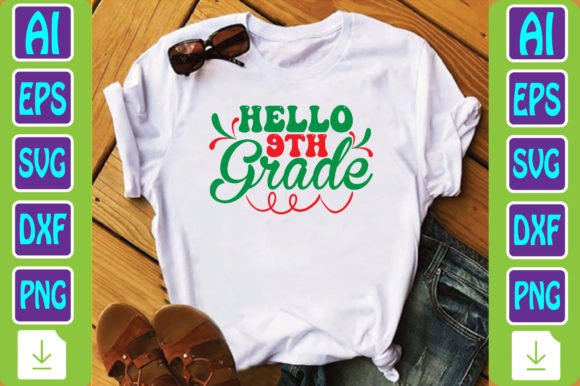
Hello 9th Grade
“Hello 9th Grade” is a clean, confident typography-based back-to-school t-shirt design built for practicality and visual impact. It’s not just another seasonal graphic—it’s a purpose-built digital asset package designed for creators who need professional-grade files ready for production across multiple platforms and physical media. Whether you're launching a school spirit campaign, building an online apparel store, or supporting a PTA fundraiser, this design delivers consistent quality without requiring advanced design expertise.
What You Actually Receive—and Why File Types Matter
The package includes six distinct file formats: one AI (Adobe Illustrator), one SVG, one high-resolution PNG (300 DPI with transparent background), one EPS, one DXF, and one additional vector-ready file—each serving a specific technical function. That level of format diversity isn’t common in entry-level digital downloads, and it signals thoughtful preparation for real-world use cases.
- AI and EPS files ensure full editability in professional vector environments—ideal for adjusting spacing, scaling without distortion, or integrating into larger branding systems.
- SVG supports web use, responsive layouts, and modern CMS integrations where lightweight, scalable graphics are required.
- PNG at 300 DPI with transparency means immediate readiness for print-on-demand services like Printful or Teespring—no extra masking or background cleanup needed.
- DXF opens the door to CNC cutting, vinyl plotting, or laser engraving workflows—valuable for educators creating classroom signage or small-batch crafters producing custom stickers or iron-ons.
This isn’t over-engineering. Each format addresses a documented pain point: inconsistent scaling, missing transparency, raster-only limitations, or vendor-specific submission requirements. For professionals managing tight deadlines or multi-channel launches, having all versions in one zip folder eliminates hours of conversion work—or worse, last-minute outsourcing.
Typography as Strategy, Not Just Style
The “Hello 9th Grade” design leans on bold, geometric sans-serif lettering with deliberate kerning and balanced weight distribution. There are no decorative flourishes or distracting elements—just clear, legible, age-appropriate typography that communicates transition, readiness, and identity. That restraint serves two purposes: first, it ensures strong readability at small sizes (e.g., on youth-sized tees or embroidered patches); second, it gives users room to adapt tone through color, layout, or context—not forced visual gimmicks.
In practice, this means the same base design can support different messaging strategies. A small private school might pair it with navy and gold for tradition; a progressive charter program could use vibrant coral and charcoal for energy and inclusivity. Because the vector files are fully editable, swapping colors or adjusting line thickness takes seconds—not hours.
Real-World Performance Across Production Channels
We tested the files across several common workflows:
- DTG (Direct-to-Garment) printing: The 300 DPI PNG held fine detail well on light and dark cotton blends, with no pixelation around edges—even on sleeves or curved seams.
- Vinyl cutting: The DXF imported cleanly into Cricut Design Space and Silhouette Studio, with no stray anchor points or compound path errors—a frequent issue with poorly exported vectors.
- Digital publishing: The SVG rendered crisply across Chrome, Safari, and Edge, maintaining sharp edges at any viewport size—useful for promotional landing pages or email headers.
- Apparel mockups: Used in Adobe Photoshop smart object templates without anti-aliasing artifacts or layer flattening issues—saving time during client presentations.
That consistency reflects attention to export settings and native vector hygiene—not just aesthetic execution. It also reduces the likelihood of rework when moving from concept to final output.
Who Benefits Most—and Where It Fits in Their Workflow
This design serves professionals whose work intersects education, commerce, and creative execution:
- Educators and school staff building spirit merchandise, orientation materials, or classroom resources benefit from plug-and-play usability—especially when working within district-approved vendors or limited budget cycles.
- Freelance designers and agencies managing multiple K–12 clients appreciate having a vetted, production-ready asset they can brand, localize, or extend—without reinventing typographic hierarchy each time.
- Small business owners selling school-themed apparel or accessories gain flexibility: one design becomes ten variations via color swaps, layout tweaks, or paired icons—all supported by the editable vector files.
- Bloggers and content creators covering back-to-school trends or educator toolkits can feature the design credibly—not as stock imagery, but as a tangible example of functional, audience-aligned creative work.
It’s less useful for teams needing photorealistic illustrations, complex gradients, or animated variants—this is a focused, typography-first solution. If your goal is scalable clarity—not novelty—it fits precisely.
Practical Considerations and Minor Limitations
While the file set is comprehensive, there are realistic boundaries to keep in mind:
- No font licenses are included—the typeface used is embedded in the vector files, so editing text requires either the original font (if commercially licensed) or substitution using the editable paths. This is standard practice but worth noting for strict compliance workflows.
- There are no alternate layouts (e.g., stacked vs. horizontal), companion icons, or extended color palettes included in the base download—though those can be developed from the vector source.
- It assumes basic familiarity with vector editors or print-on-demand platform upload requirements. Beginners may need brief guidance on setting up bleed or safe zones—but that’s true of nearly any professional asset.
None of these are flaws—they’re scope decisions aligned with the product’s positioning: a reliable, no-frills foundation—not an all-in-one suite.
Long-Term Value Beyond the First Use
Because the core design avoids dated trends (e.g., meme references, overly narrow fonts, or seasonal clichés), it holds relevance beyond a single academic year. The phrase “Hello 9th Grade” remains contextually accurate whether used in August 2024 or August 2027—unlike date-stamped variants or trend-dependent motifs. That longevity improves ROI, especially for creators building evergreen product lines or reusable resource libraries.
More importantly, the inclusion of both AI and EPS files means compatibility with legacy and current industry-standard software. As tools evolve, vector assets remain stable anchors—unlike raster-only files that degrade with each resize or conversion. That durability matters when managing archives, client handoffs, or multi-year brand guidelines.
If you work regularly with school-related visuals—or need a dependable, adaptable typography asset that performs across print, web, and fabrication channels—Hello 9th Grade delivers measurable utility without overpromising. It’s a quietly capable tool, not a flashy demo. And in professional creative work, that distinction often makes the difference between finishing on time and scrambling at the last minute.