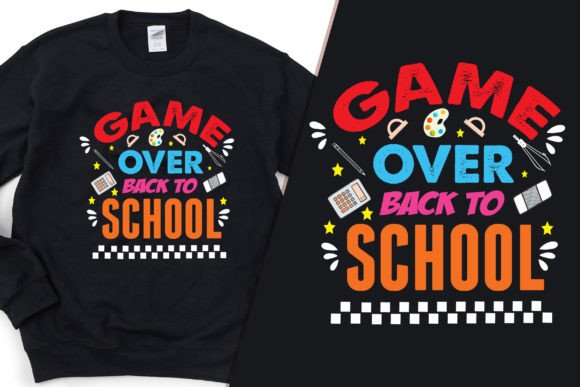
Ready to School, Game Over T-Shirt SVG: Retro Nostalgia Meets Modern Design Workflow
“Ready to School, Game Over” isn’t just a playful twist on classic arcade phrasing—it’s a cultural signal. When paired with an SVG file for a custom t-shirt design, it becomes a functional, shareable, and highly adaptable creative asset. For designers, educators, small business owners, and hobbyists alike, this specific SVG represents more than retro aesthetics: it’s a convergence of accessible digital craftsmanship, expressive personal branding, and evolving expectations around self-expression in everyday wear.
What Is a Ready to School, Game Over T-Shirt SVG—And Why Does It Matter?
An SVG (Scalable Vector Graphic) is a resolution-independent file format ideal for print-on-demand, embroidery digitizing, or Cricut/Silhouette cutting. A “Ready to School, Game Over” SVG isn’t merely clipart—it’s a thoughtfully composed vector file optimized for clarity at any size, with clean paths, layered color groups, and intentional spacing between text and graphic elements. Unlike raster files (JPG, PNG), SVGs retain crisp edges when scaled up for large-format prints or resized down for pocket logos—making them especially valuable for creators who juggle multiple output formats across platforms.
This particular phrase taps into two resonant cultural currents: the resurgence of 70s-inspired typography and psychedelic color palettes, and the growing appetite for lighthearted, self-aware messaging in apparel. “Ready to School” nods to lifelong learning and professional growth; “Game Over” adds ironic levity—acknowledging burnout, pivots, or the simple joy of stepping away from screens. Together, they form a micro-narrative that feels both timely and timeless.
Retro Style, Reimagined for Real Workflows
The 70s revival isn’t about costume—it’s about texture, intentionality, and tactile authenticity. Today’s consumers don’t just want vintage looks; they expect vintage *feeling*: soft ring-spun cotton, relaxed unisex fits, and dyes that fade gracefully over time. That’s why the “Ready to School, Game Over” t-shirt isn’t printed on generic blanks. It’s built on premium fabric engineered for durability and breathability—important for educators leading full-day workshops, freelancers attending back-to-back client calls, or entrepreneurs wearing their brand at pop-up markets.
More importantly, the design’s vector foundation supports real-world flexibility. A marketer can drop the SVG into Canva to mock up social posts. A teacher can import it into Google Slides to create classroom posters. A small-batch apparel seller can adjust stroke weights and color values in Illustrator before sending to a DTG printer—all without losing fidelity. That interoperability reflects a broader shift: creative tools are no longer siloed. Professionals expect assets to move seamlessly between ideation, production, and distribution.
From Niche Nostalgia to Mainstream Utility
Fifteen years ago, retro-themed apparel often leaned heavily into kitsch—think exaggerated flares and fluorescent fonts meant for Halloween, not Monday meetings. Today’s interpretation is more nuanced. The groovy swirls and sunburst motifs in this design use balanced saturation, intentional negative space, and legible type hierarchy—so it reads clearly at arm’s length but rewards closer inspection. That subtlety makes it viable beyond festivals or themed parties: it works tucked into high-waisted trousers during a team offsite, layered under an open denim shirt at a co-working space, or worn untucked with tailored shorts for a school pickup run.
This evolution mirrors how audiences engage with nostalgia itself. We’re no longer mimicking the past—we’re curating its most human elements: warmth, imperfection, playfulness. That’s why “Ready to School, Game Over” resonates across age groups. A 28-year-old content creator sees wit and relatability. A 45-year-old curriculum designer recognizes the gentle nod to pedagogy and resilience. Even educators ordering class shirts appreciate how the phrase invites conversation—not just about games, but about growth mindsets and resetting after setbacks.
Practical Implications for Creators and Businesses
If you're building a side hustle, launching merch for your podcast, or designing staff apparel for a learning studio, this SVG offers tangible advantages:
- Speed to market: No need to commission original artwork—this file arrives production-ready, with color-separated layers for screen printing or CMYK-optimized versions for direct-to-garment runs.
- Brand consistency: Easily recolor the SVG to match your existing palette (e.g., swapping electric orange for deep indigo) while preserving visual cohesion across t-shirts, tote bags, and digital banners.
- Inclusive sizing integration: Because the design scales cleanly, it maintains proportion across XS–5XL garment blanks—no awkward cropping or distorted lettering on extended sizes.
- Educational utility: Teachers report using the phrase as a lighthearted transition cue (“Okay team—Ready to School! … Wait, no—Game Over on that tangent. Let’s reset.”), turning apparel into a subtle classroom tool.
It’s also worth noting how AI-assisted tools now complement—not replace—these assets. You might use AI to generate alternate taglines (“Level Up Your Lesson Plans”, “Ctrl+Alt+Del the Ordinary”) for A/B testing on social ads, but the core SVG remains the anchor: consistent, human-crafted, and intentionally imperfect in ways algorithms still struggle to replicate authentically.
Wearing Meaning, Not Just Messaging
Apparel has quietly become one of the most effective forms of nonverbal communication in hybrid work environments. A well-chosen t-shirt signals values faster than a LinkedIn headline: curiosity, humor, boundary awareness, or commitment to craft. “Ready to School, Game Over” sits comfortably in that space—it doesn’t shout ideology, but it does invite alignment. It says, “I take learning seriously—and I know when to pause.”
That duality reflects larger lifestyle shifts: professionals increasingly prioritize sustainable consumption (hence the emphasis on durable fabric and ethical manufacturing), value experiences over accumulation (so a t-shirt becomes part of a memory—not just inventory), and seek products that support identity *and* function (e.g., moisture-wicking blends for summer conferences, or seamless side seams for all-day comfort during long editing sessions).
For creators distributing this design, transparency matters. Clearly stating fabric origin, care instructions, and whether the SVG includes commercial-use licensing builds trust—especially among educators and small studios operating on tight budgets and tighter timelines.
A Thoughtful Entry Point Into Wearable Storytelling
“Ready to School, Game Over” isn’t trying to solve every problem in apparel design—but it does solve several quietly important ones. It bridges generational visual language without leaning on cliché. It delivers retro charm with modern usability. And it transforms a simple garment into a quiet conversation starter, a confidence booster, or even a gentle reminder to recalibrate.
Whether you’re uploading the SVG to your Etsy shop, adapting it for a nonprofit’s fundraising campaign, or wearing it to your next portfolio review, its strength lies in restraint: bold enough to be seen, thoughtful enough to be remembered, and versatile enough to grow with you—not just this season, but across projects, roles, and phases of life.