My First Week Back at School: A Printable Journal Guide for Smooth, Joyful Transitions
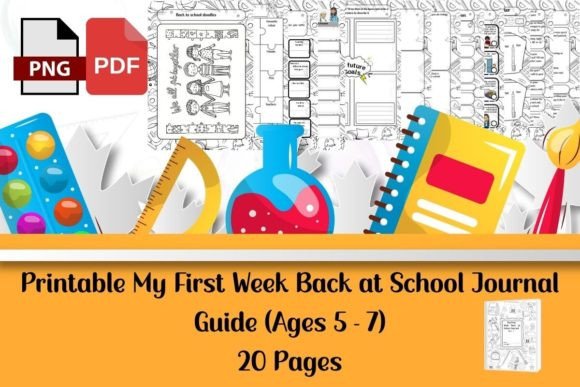
Returning to school after a break—whether it’s summer, winter holidays, or even a short family trip—can stir a complex mix of emotions in young children. Excitement about seeing friends and learning new things often tangles with uncertainty about routines, classroom expectations, or even simple logistics like where to hang their backpack. For children aged 5 to 7, this emotional landscape is still developing, and abstract reassurance rarely lands as effectively as tangible, hands-on experiences. That’s where Printable My First Week Back at School steps in—not as a checklist, but as a gentle, child-centered companion designed to transform transition anxiety into curiosity, agency, and joyful reflection.
Why the First Week Matters More Than We Often Realize
The first five days of any school term function as a neurological and social “setup period.” During this time, children aren’t just learning spelling rules or counting strategies—they’re mapping their environment, testing social boundaries, internalizing behavioral cues, and building mental models of how their new classroom “works.” Research in early childhood education consistently shows that students who experience consistent, positive, and predictable entry routines demonstrate stronger engagement, improved self-regulation, and greater academic persistence by mid-term. Yet many schools lack capacity to individualize this onboarding—especially for neurodiverse learners or those adjusting to new settings (e.g., moving from preschool to kindergarten or switching schools).
This is where purpose-built tools like Printable My First Week Back at School fill a quiet but critical gap. It doesn’t replace teacher-led orientation—it extends it. By giving children a familiar, low-stakes way to process each day’s events, it supports memory consolidation, emotional labeling, and metacognitive awareness—all foundational skills for lifelong learning.
How the Journal Works: Structure Rooted in Developmental Science
Unlike generic coloring pages or fill-in-the-blank worksheets, Printable My First Week Back at School is structured around three interlocking developmental pillars: predictability, expression, and participation.
- Predictability: Each day features a simple visual schedule icon (e.g., “Circle Time,” “Lunch,” “Recess”) paired with a gentle prompt (“What did you do during circle time?”). This scaffolds executive functioning by helping children anticipate sequence and reduce cognitive load associated with uncertainty.
- Expression: Prompts invite multimodal responses—drawing, tracing, circling, writing single words, or dictating to an adult. One page asks, “Draw one thing you learned today,” while another invites children to color in a smiley face showing how they felt at lunchtime. This honors diverse communication styles and avoids privileging literacy over other forms of understanding.
- Participation: Several pages include collaborative elements—for example, “Ask your teacher one question tomorrow” or “Find someone who likes the same book as you.” These nudge social connection without pressure, turning passive observation into intentional interaction.
The design also reflects sensory-aware considerations: generous white space, clear sans-serif fonts, thick borders for easy cutting or laminating, and minimal visual clutter. Educators using the journal in inclusive classrooms report that children with attention regulation challenges often gravitate toward its rhythmic structure—returning to the same format daily builds familiarity faster than novel activities.
Real-World Applications Across Contexts
While originally conceived for home use before and after school, Printable My First Week Back at School has evolved organically across multiple settings—each revealing distinct advantages.
In Homeschool and Hybrid Learning Environments
Families navigating flexible schedules find the journal especially valuable when reintegrating formal learning rhythms. One parent shared how her 6-year-old used the “Today I Tried…” prompt to document experimenting with a new math manipulative—turning a moment of frustration into visible progress. The physical act of coloring the “I Did It!” star at the bottom of each page became a ritual that reinforced effort over outcome.
In Early Elementary Classrooms
Teachers report using the journal in three distinct ways: as morning warm-ups (students respond to “One thing I’m curious about today”), as part of transition-time reflection (e.g., “What helped you feel calm during fire drill practice?”), and as a low-pressure assessment tool. Because entries are open-ended and non-graded, they reveal insights standardized assessments miss—like a child quietly naming their fear of the loud bell, or expressing pride in tying their shoes independently for the first time.
In Therapeutic and Support Settings
Occupational therapists and school counselors have adapted pages for emotion identification work. The “How My Body Felt Today” section—featuring simple body outlines with labeled zones (head, chest, hands)—helps children connect physical sensations (e.g., “my hands felt wiggly”) to emotional states (“that was when I got excited”). This bridges somatic awareness and verbal expression—a key goal in trauma-informed and neurodiversity-affirming practice.
What Sets This Apart From Other Back-to-School Resources
There’s no shortage of back-to-school printables online: supply lists, name tags, behavior charts. But few prioritize the child’s internal experience over logistical preparation. Printable My First Week Back at School distinguishes itself through intentionality in three areas:
- Developmental Precision: Every prompt aligns with typical milestones for ages 5–7—including emerging narrative skills, growing symbolic representation (e.g., drawing a person with 6+ body parts), and increasing capacity for self-reflection (“I felt brave when…” rather than just “I liked art”).
- Adult Partnership Design: Notes for caregivers and educators appear discreetly in margins or on separate guidance sheets—not as instructions, but as reflective questions (“What might your child be communicating through their drawing?”). This avoids prescriptive language and centers responsive, relationship-based support.
- Adaptability Without Compromise: The PDF is optimized for both digital annotation (on tablets with styluses) and physical printing. Pages can be printed individually, bound into a booklet, or laminated for dry-erase reuse. No login, subscription, or app required—just immediate access and flexibility.
Thoughtful Implementation: Beyond Just Printing
Simply downloading and handing over the journal won’t maximize its impact. Its effectiveness grows when integrated mindfully into existing routines. Here’s what works well in practice:
- Start small: Introduce only Day 1 on Sunday evening—not as homework, but as a shared story time. Read the prompts aloud, model a response (“Hmm, I wonder what snack you’ll have tomorrow?”), and let your child choose how to engage (draw, point, say, or pass).
- Protect the “why”: Avoid framing completion as a task to be checked off. Instead, anchor it in belonging: “This helps us remember all the cool things you’re doing—and how strong you are for trying new things.”
- Embrace imperfection: A blank page isn’t failure—it’s data. If your child resists drawing, try offering stickers, stamping, or taking a photo of their artwork to paste in. The goal is connection, not compliance.
- Loop in the teacher: With permission, share anonymized excerpts (e.g., “My child drew their teacher holding a big book—looks like story time made an impression!”). This builds continuity between home and school without overburdening staff.
Observations From Early Users
Since its release, educators and families have shared nuanced observations that deepen our understanding of how such tools operate in real life:
One kindergarten teacher noticed that children who used the journal consistently showed earlier mastery of classroom jobs—likely because the “Who Helped Me Today?” prompt normalized asking for and offering support. A speech-language pathologist observed increased spontaneous use of temporal language (“first,” “then,” “after lunch”) among clients using the journal alongside therapy goals. And several parents described unexpected emotional breakthroughs—like a child whispering, “I didn’t draw anything on Wednesday because I missed you,” after weeks of stoic silence about separation.
These aren’t isolated anecdotes. They reflect how consistent, low-stakes reflection builds narrative identity—the sense that “I am someone who notices, feels, tries, and belongs.” That foundation supports everything from decoding phonics to resolving peer conflicts.
Supporting Broader Educational Priorities
In an era where social-emotional learning (SEL) is increasingly recognized as inseparable from academic growth, resources like Printable My First Week Back at School serve dual purposes. They operationalize SEL competencies—self-awareness, self-management, social awareness—within authentic, everyday contexts. Unlike standalone SEL curricula that can feel abstract or disconnected, this journal embeds skill-building directly into the rhythm of school life.
It also aligns with universal design for learning (UDL) principles: offering multiple means of engagement (choice in response format), representation (visual + verbal + kinesthetic cues), and action & expression (drawing, writing, speaking, selecting). When accessibility is built in—not added on—it benefits all learners, not just those with identified needs.
For school leaders evaluating classroom resources, this journal represents scalable, low-cost, high-leverage support. It requires no training, fits seamlessly into existing structures, and generates meaningful qualitative data about student well-being—data that complements quantitative metrics like attendance or assessment scores.
Final Thought: Preparing Hearts Before Heads
Preparing a child for school goes far beyond sharpening pencils and labeling lunchboxes. It’s about preparing their heart to feel safe, their mind to stay curious, and their body to trust the rhythm of the day. Printable My First Week Back at School meets children where they are—not as empty vessels to be filled, but as capable, feeling, observant humans ready to make meaning from their experiences. It doesn’t promise perfection. It offers presence. And in those first five days, presence—consistent, warm, and attentive—is the most powerful curriculum of all.