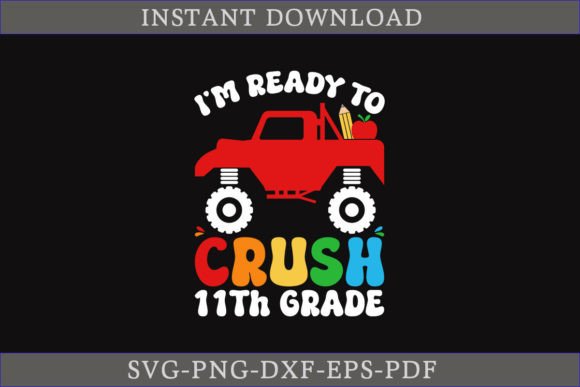
I'm Ready to Crush 12th Grade SVG: A Practical Design Asset for Educators, Creators, and Small Business Owners
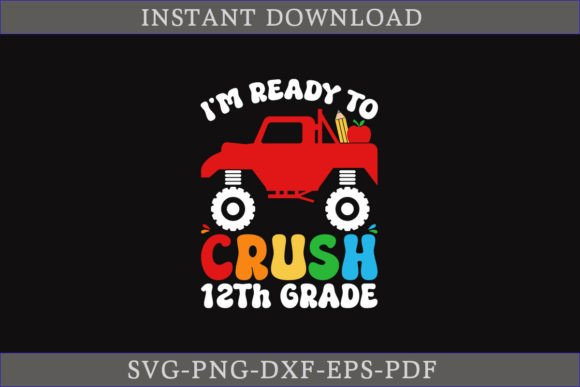
When you're designing custom apparel for a senior class fundraiser, launching a back-to-school merch line for your tutoring business, or preparing motivational printables for a college readiness workshop, having a polished, production-ready design saves hours of setup time. The I'm Ready to Crush 12th Grade SVG is one such asset—not just decorative text, but a workflow-optimized vector file built for real-world implementation across digital and physical outputs.
What This File Is—and What It’s Not
This isn’t a static PNG overlay or a low-res social media graphic. It’s a tightly constructed vector package containing five industry-standard formats—SVG, DXF, EPS, PNG, and PDF—all compressed into a single ZIP archive. Each format serves a distinct purpose in a broader production pipeline: SVG for web use and Cricut Design Space, DXF for Silhouette Studio and laser cutters, EPS for professional print prep in Adobe Illustrator, PNG for quick mockups or non-vector workflows, and PDF for universal sharing or offline review.
The design itself is intentionally clean and bold—no excessive gradients, no embedded raster effects, no locked layers. Every element is built from 100% vector shapes, meaning it scales infinitely without pixelation, whether you’re printing it on a 3-inch sticker or a 24-inch poster. And because it’s fully editable in Illustrator (EPS 10+ compatible), Affinity Designer, Inkscape, or even browser-based tools like Vectr, you can adjust spacing, reposition elements, or swap fonts without breaking alignment.
How It Fits Into Your Existing Workflow
For educators and school staff, this file integrates directly into lesson planning and event coordination. Use it early in the semester to create welcome banners for senior orientation, embed it into Google Slides templates for college application workshops, or import it into Canva to build printable “Senior Success Checklist” handouts. Because color changes are one-click in most vector editors (just select the shape and apply a new fill), you can match school colors or district branding in under 90 seconds—no redesign needed.
Small business owners running tutoring centers, graduation photography studios, or custom apparel shops use it as a modular component in larger product systems. For example, pair the I'm Ready to Crush 12th Grade SVG with a customizable name field (as a separate text layer) and a school mascot icon (imported separately) to generate personalized t-shirt mockups for client approvals. That same base file becomes the anchor for vinyl-cut decals on water bottles, heat-transfer designs for hoodies, or even engraved acrylic keychains—each requiring only minor format selection and size adjustment.
Compatibility and Setup: What You Need to Know Before Opening the ZIP
You’ll need to unpack the ZIP first—this isn’t a single-file download. Once extracted, verify that all five formats are present. If you’re using Cricut Design Space, start with the SVG. For Silhouette Studio, use the DXF (it imports more reliably than SVG for complex outlines). For commercial print vendors, send the EPS or PDF—both preserve vector integrity and embed fonts properly. Avoid using the PNG unless you’re placing it into a non-editable layout (e.g., a newsletter template) where resolution isn’t critical.
All files are layered logically: main text group, optional underline or badge element (if included), and background shape (if any)—each on its own layer. That structure means you can hide or delete components without affecting others. For instance, remove the underline before sending to a screen printer who charges by color separation, or isolate the text group to add a subtle drop shadow in Photoshop for a social media banner.
Practical Implementation Tips for Consistent Results
- Test before scaling: Even though it’s vector, zoom in at 400% in Illustrator after resizing to confirm stroke weights and spacing remain legible—especially if reducing below 1.5 inches tall for stickers.
- Check color mode: Switch to CMYK before sending EPS/PDF to a print shop; keep RGB for web or Cricut projects. Most editors auto-detect, but manual verification prevents unexpected hue shifts.
- Name your layers clearly: When adding custom elements (e.g., a student’s name or graduation year), label those layers distinctly (“Personalization_Text”) so team members or contractors understand what’s editable versus locked branding.
- Use consistent export settings: For PNGs intended for web use, export at 72 PPI with transparent background. For high-res mockups, use 300 PPI and sRGB color profile.
Long-Term Use and Version Control
Treat this file like any other core brand asset—store it in a dedicated “School Year Assets” folder alongside your logo variants and style guide. Rename copies thoughtfully: Crush12_SeniorClass2025_SVG, Crush12_TeacherVersion_EPS. That way, when next year’s seniors need a refreshed version (perhaps with “2026” or a different font weight), you’re not hunting through downloads—you’re building incrementally.
If you maintain multiple product lines (e.g., “Crush 12th Grade”, “Survived AP Bio”, “Graduation Countdown”), keep them in the same naming convention and folder structure. That consistency reduces cognitive load during peak season—like August inventory prep or April prom-order surges—and supports bulk processing in automation tools like Adobe Batch Export or Folder Actions on macOS.
Where It Adds Real Efficiency—Not Just Aesthetic Polish
Time saved isn’t theoretical. One freelance designer reported cutting average merch turnaround from 3.5 hours to 45 minutes per client after standardizing on editable SVG assets like this one. An after-school program coordinator reduced volunteer training time by 60% by replacing verbal instructions with annotated SVG-based setup guides for t-shirt heat presses.
The value isn’t in the phrase itself—it’s in how cleanly it moves across platforms, how reliably it renders across devices, and how flexibly it adapts to shifting needs. Whether you’re prepping for a single classroom activity or scaling to 200+ students across three schools, the I'm Ready to Crush 12th Grade SVG functions as infrastructure, not decoration.
Final Integration Note: Start Small, Scale Intentionally
Don’t try to use all five formats at once. Pick one use case that’s currently causing friction—say, creating last-minute spirit wear for a senior pep rally—and solve that first with the SVG version in Cricut Design Space. Once that’s stable, expand to DXF for custom stickers or EPS for printed posters. Each step reinforces familiarity with the file’s behavior, making future adaptations faster and more confident.
That kind of deliberate, iterative integration is how practical design assets earn long-term trust—not through flash, but through reliability across dozens of real tasks, tight deadlines, and changing technical constraints.